
Friday Reading S14E10
 by Martin Belam, March 27, 2026
 A weekly round-up of what I’ve read and enjoyed from around the web.
I’m interested in journalism, media, technology, and nerdy things found down the back of the world wide web’s sofa. Most weeks I publish a handful of things I’ve read that caught my eye – regardless of what the algorithms were pushing at me. You can subscribe to get it by email here. And if you read something odd and wonderful you think I’d enjoy, feel free to send it my way.

Mic Wright is scathing here on the exposure that Matt Goodwin’s new so-called book has happily regurgitated hallucinated references from ChatGPT without fact-checking getting a look in at all.
“Putting aside the intellectual dishonesty that runs through Goodwin’s work, like the message in a peculiarly poisonous stick of Blackpool rock, there’s a wider danger from this kind of book. Those fabricated quotes will enter the information stream and, when generative AI gobbles them up, will end up being treated as real.”
Read more here: Mic Wright, Byline Times – MattGPT: The Sorry Tale of Matt Goodwin’s AI-Assisted, Fake-Quote-Filled New Book
I have moaned many many times that if the people planning and building HS2 had been the people planning and building the west coast mainline, it would never have got finished because there would have been some spurious calculation suggesting the stretch around Carlisle would never be profitable and you can get to Glasgow from Edinburgh anyway. I was very much struck by this quote from HS2 chief executive Mark Wild in an article that suggests the top speed of the trains is going to be capped lower to save money:
Speed has never been the primary objective. This railway will deliver better journeys, more capacity on the network, and economic growth – all of which are vital to the country’s future prosperity.
The problem, of course, is that the whole project was very much sold to the public on the idea it would make the London-Birmingham journey faster. This 2020 essay by Alex Hern arguing that the promise of speed with both HS2 and 5G was a ludicrous mis-selling has long lived with me.
“Both [HS2 and 5G] are massive infrastructure projects, which won’t pay off til years after work begins, and require the co-operation of government and industry at the highest levels. Both, too, were basically far too far along by the time the public started paying attention to them for them to ever really be substantially tweaked. And both have absolutely fucked up their public messaging by focusing on speed.
Speed is nice for marketing folk. It’s sexy, it’s obvious, it’s cool. Even if it’s just a fast train, the ability to say that that train is faster than the previous one is an obvious sell. And so it’s no surprise that, if you look at the messaging for both 5G and HS2, you’ll see speed front and centre. I mean, it’s literally in the name of HS2.
But the problem is that in both cases, speed is effectively tangential to the real reason for the infrastructure build-out, which is capacity.”
Read more here: Alex Hern, The World Is Yours* – HS5G2
“The war is a video game, a spectator sport, a social media festival of dunking” is Nesrine Malik’s verdict on how Trump’s AI, memes and a simplistic narrative have flattened the conflict in Iran.
This is far too long from Wayne Horkan on the rise of the age-gated internet but his core point resonated with me:
“Governments around the world are introducing age-verification and youth social-media laws, but these policies may be doing far more than protecting children. They are quietly pushing identity into operating systems, app stores, and the core infrastructure of the internet, shifting governance down the stack and creating new enforcement chokepoints. Along the way, they reshape platform power, favour large incumbents.”
Read more here: Wayne Horkan, Horkan – The age-gated internet: child safety, identity infrastructure, and the not so quiet re-architecting of the web
Former colleague Hannah Ray has a new book out, and has written about what moved her to write about motherhood.
“Everyone else seemed to go on in the pretence. Like it’s not about creating new life, and being an animal, and the blood, and guts, and the raw close-to-death experience of it all. I saw motherhood as slippery as the slime you see kids playing with. Society was asking me to hide this gloop into neat, sanitised boxes. But it kept spilling out. My preconceptions of writing about motherhood were just as dripped in the patriarchy as most of my pre-parenthood ideals. I saw the subject matter as weak because I’d been trained into thinking women move into weakness when they shape-shift into mothers.”
Read more here: Hannah Ray, Tell Their Stories – Mother, Inc. — my new book — is available now

The Guardian’s media editor Michael Savage sadly neglected to add “What the hell is going on with Doctor Who?” into this otherwise very useful list of six urgent issues for BBC’s new boss, Matt Brittin.

Enjoying Friday Reading by email? Feel free to forward it to a friend – they can sign up here. And if you’ve recently read something you think I would enjoy, do send it my way.

This week’s Guardian Thursday news quiz: Security scrapes, sordid statues and feral ferrets.

Questioning man illustration: Anaïs Mims. Guest animal: Mr Foxy of Walthamstow

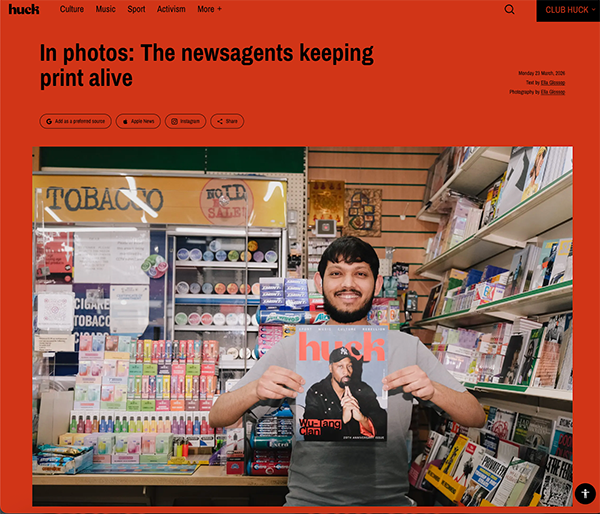
This is a rather cute conceit, as Huck magazine’s Ella Glossop visits and photographs some of the increasingly diminishing number of newsagents who still stock big ranges of print magazines.
Fotohane Darkroom is a space for the children of Mardin – a Turkish city that borders Syria and Iraq – to learn how to shoot, develop, and print their own analogue photographs, giving them the chance to tell their stories themselves, Flora Medina reports for i-D magazine.
“When political strife, international conflict, and forced migration take hold, pause becomes even more powerful. It’s a strength that Amar Kılıç and Serbest Salih felt firsthand living in Mardin, Turkey. The city has migration woven into its existence. It sits on the border of Syria and Iraq—two places affected by heavy military presence, largely at the hands of the US government, driving out many native residents. They wanted to make a space for the children of the city to connect with each other and express themselves creatively, and so founded Fotohane Darkroom.”
Read more here: Flora Medina, i-D magazine – A city of borders, seen through a child’s lens

Among other things I discovered in this Catherine Slessor piece about Henry Moore’s house, Hoglands, is that his statues were so controversial at the time some got vandalised.
A series that never disappoints, this week’s pet I’ll never forget is Harriet the hedgehog, who took to living in Roger Leitch’s airing cupboard.

Keith Stuart is always very readable doing the Pushing Buttons newsletter, and here outlines a new passion for a new way of spending his money on fragile video-game nostalgia.
“And as the game industry has been terrible at archiving its own history, anyone who buys and looks after these fragile objects, is performing an act of vital preservation and curation. You may find many of these video demos and cartoons on YouTube, but always, always, the primary artefact itself – its packaging, its smell, its quirks, its frailties – is part of the experience of understanding and appreciating history. That’s what I tell myself, anyway.”
Read more here: Keith Stuart, Pushing Buttons – My quest to preserve VHS-era gaming culture, one eBay bid at a time
I am of an age where online shooters are just a hiding to nothing due to the reaction time and dedication of the younglings, but I remain interested in the ecosystem, which seems increasingly unsustainable.
“Highguard’s implosion was swift. According to Bloomberg, 90% of the game’s players had abandoned it a week later. After a month, developer Wildlight Entertainment announced that it would end service on 12 March, after fewer than 50 days online. As you read this, it is already too late. Highguard is gone, and the 2 million players Wildlight says logged on to the game could not come back if they wanted to. Two million players. And yet this game is a flop.”
Read more here: Joshua Rivera, The Guardian – In the killer world of online gaming, there are no hits any more – just survivors

I was bewitched last week by Trains (2024, dir Maciej Drygas) and so ended up writing a little mini-essay about it:
“The premise of Trains is simple: archive footage, no narration, tracing trains across the 20th century from pre-first world war through to the aftermath of the second. In doing so, it manages to tell an extraordinary social history without ever needing words.”
Read more here: Martin Belam, martinbelam.com – Thoughts on … Trains (2024) – Maciej Drygas


One of those lovely olden-times quirky football stories about the English manager who took Sweden to the 1958 World Cup final and then the only job he could get back home was with non-league Skegness Town.
Tonight’s friendly with England brings the hugely popular Elland Road legend Marcelo Bielsa back to England four years after leaving Leeds United. Jonathan Wilson analyses his Uruguay tenure as Bielsa heads towards his third World Cup.

Billy Bragg and Rosa Walton of the experimental pop duo Let’s Eat Grandma are among those delivering 10 expert tips on how to become more musical.
My contributions to the Guardian’s First Edition newsletter this week were:
· Monday briefing: What a new Guardian podcast reveals about the US justice system
· Wednesday briefing: Can Sarah Mullally steer the Church of England back into safer waters?
· Friday briefing: Can the left mobilise itself to outmarch the momentum of the far right?
Friday Reading is a (usually) weekly series of recommended reads from Martin Belam, covering journalism, media and technology, and other interesting nerdy things found on the internet. It is now in its fourteenth season. Sign up here to receive it by email.
by Martin Belam, March 27, 2026 I do live blogging, news stories and quizzes at the Guardian, and help cover Eurovision and Doctor Who for them too. As a journalist and designer I’ve spent over 25 years building digital products for the likes of Sony, the Guardian, the BBC, the Natural History Museum, Arts Council England and Reach (formerly Trinity Mirror). You can contact me at martin.belam@theguardian.com. Sign up to get my blog posts sent to you via email.